Serra de Arga Equestrian Trail


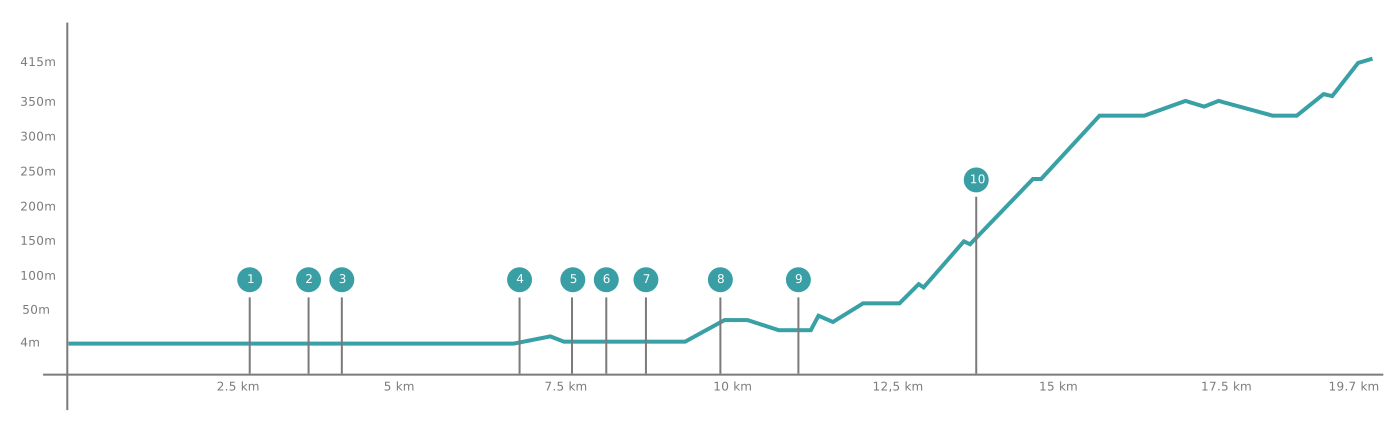
The Serra de Arga Equestrian Trail, approximately 36 km in length, crosses three municipalities — Viana do Castelo, Caminha and Ponte de Lima. This circular route encircles the entire Serra de Arga mountain massif, following ancient rural and livestock-grazing paths.
It runs at altitudes ranging from 300 to 500 metres, along the base of the central granite batholith of the Serra de Arga, linking the main mountain villages: Montaria, Cerquido, Dem, Arga de São João, Arga de Baixo and Arga de Cima. These settlements, which concentrate human occupation in the mountain area, are situated on gently sloping terraces and less rugged sections of terrain that interrupt the gradient of the hillsides. Their accumulated sediment deposits make these areas more fertile, favouring agricultural activity.
Above 500 metres, the imposing granite formations shape the mountain's wilder character, softened by the varying hues of natural mountain pastures, with their remarkable floristic diversity, and heathland. Particularly noteworthy are the Galician-Portuguese gorse and heather communities (*urzais-tojais galaico-portugueses*), which flower between April and May, painting the mountain slopes in shades of yellow and violet and creating a landscape of striking natural beauty. Garrano ponies are frequently spotted here, as this is their natural habitat, where they live in a semi-wild state.
By contrast, the landscape surrounding the rural settlements is characterised by a network of streams and cultivated fields, often arranged in terraces and divided and supported by dry-stone walls built from schist and granite. In the villages, the imposing character of granite vernacular architecture stands out. Several examples of traditional houses remain, reflecting the architectural characteristics of the Alto Minho region. These typically have two storeys: an upper residential floor and a lower floor occupied by animal stalls, alongside which are the farmyard, threshing floor and traditional raised granaries. Also noteworthy are the numerous horizontal-waterwheel mills, irrigation channels, bridges, smaller stone crossings, fountains and communal washing places.
Starting from the centre of the parish of Montaria, you can ride this equestrian trail in either direction.
Heading north-west, the route takes you to the village of Dem, covering a distance of 11 km along the mid-slopes of the western face of the Serra de Arga. This is a centuries-old route, rich in symbolism, which follows a path close to that once taken by pilgrims travelling to Santiago de Compostela. Their itinerary, coming from Barcelos, crossed the River Lima at Lugar da Passagem (Moreira de Geraz do Lima) and, from Lanheses, climbed towards São Lourenço da Montaria. The path crossed the Serra de Arga, continuing towards Dem and Vilar de Mouros, before crossing the River Minho at Vila Nova de Cerveira (Almada, 2000). From Dem, the route continues to Arga de Baixo, following the northernmost, north-west-facing slopes of the Serra de Arga. From Arga de Baixo, it heads towards Cerquido, crossing the eastern side of the mountain range.
If, instead, you head south-east from Montaria, you will make your way towards the picturesque village of Cerquido, following a mountain trail that climbs from 300 to 450 metres above sea level along the southern slopes of the Serra de Arga. The route follows ancient pilgrimage paths as far as Quartéis de Santa Justa. Throughout this section, you can enjoy breathtaking views over the valleys of the Estorãos and Lima rivers.
Human settlement in this part of the Serra de Arga dates back to the Iron Age. Its development was influenced not only by the favourable conditions for agriculture, in terms of landform, soil characteristics and water availability, but also by the presence of mineral deposits in Arga de Baixo, Arga de Cima and Estorãos, particularly at the sites of Cavalinho, Cova dos Mouros and Cerquido.
ALMADA, José Loureço de (2000). A Caminho de Santiago - Roteiro do Peregrino, Lello Editores, Porto.